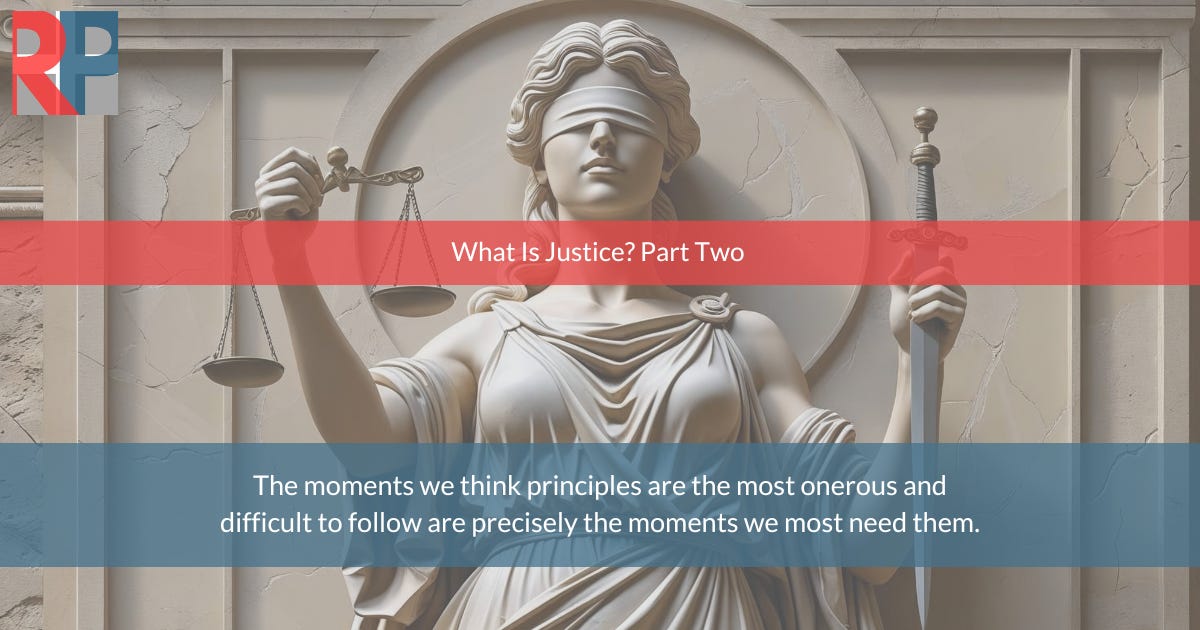
What is Justice? Part Two
If principles were easy, we wouldn’t need them.

In part one we outlined three things you have to do if you believe in justice. You have to:
Use the word “ought” because justice implies moral standards
Confront evil honestly because you have to face a problem to solve it, and
Enact and evolve solutions because no system of justice is perfect and improvements are always needed.
Injustice changes. The same old evils dress themselves up in new masks for every age and culture. But regardless of evil’s disguises and adaptations, to establish justice we rely on principles that don’t change and are applied equally.
Principles are the same yesterday, today, and tomorrow. Our constitution has many principles that we can lean on when new forms of injustice come over the horizon.
If you can’t afford the Substack monthly subscription level, but still want to support this work, “Buy me a book” with a one time or recurring gift of what you can afford at the link below.
Here’s an outline of what is below the paywall:
Justice must be established and provided.
Justice must constantly be examined and maintained.
Justice must aid the vulnerable
Principles Are Hard
Justice must be established and provided.
We inherently long for justice, but we don’t inherently enact it.
We see this principle in our founding document, the Constitution. Laws should establish justice, ensure tranquility, and defend and promote the welfare of all people equally. Tranquility, safety, and welfare are not naturally occurring. Equality is not naturally occurring. They require people and systems to create and promote them, and to defend them when they are threatened or violated.
We can’t just expect justice to “happen,” even if laws are on the books. Justice has to be actively pursued.
Justice must constantly be examined and maintained.
Partiality and corruption naturally creep into human systems and systems of justice are not exempt.
Our founders hoped that the separation of powers and the complex system of checks and balances they created in our constitution would prevent corruption from overwhelming justice. This is why violations of checks and balances and the consolidation of power is such a terrifying thing to watch happening to our government.
Justice must aid the vulnerable
In ancient times, the most vulnerable groups were foreigners, widows, orphans, and the poor. These groups are still vulnerable today, but any group that is easily taken advantage of or crushed by those in power could be considered part of the vulnerable.
The justice system must always be impartial, however, the vulnerable are most reliant on the courts for protection and the powerful most able to bend and corrupt the system to their wills. Only in court can the poor have a chance of standing on equal footing with the wealthy. And even there, money buys many lawyers and sometimes judges.
Therefore, like a sailboat in heavy crosswinds, the justice system must “set its sails” and “keep pressure on the rudder” to prevent being blown off course by the powerful. This does not mean bias or partiality in favor of the poor, but it does mean taking steps to reduce the advantages of the wealthy.
The Bill of Rights is one of the main ways our founders tried to “set the sails” to prevent abuses of power. Due process and equal protection which are guaranteed in the 4th amendment are one example. When all people are guaranteed the same processes and protection under the law, it compensates for the differences in their resources.
This is why due process is so important for all people. A chain is only as strong as its weakest link and our justice system is only as good as the justice that can be obtained by the vulnerable.
Principles Are Hard
If principles were easy, we wouldn’t need them.
Our world is full of people telling us that principles are losing propositions, character is cowardly, integrity is for idiots, and loyalty is a liability. It’s not true.
The moments we think principles are the most onerous and difficult to follow are precisely the moments we most need them. Principles are not about whether we will win. They are about who we will be whether we win or lose.
When we say that there are things in which we must persist, understanding justice and its principles under our Constitution is one of those things.
I’ve got more principles to add in part three. Please stick with us.
I try to post about principles that are true now, true in the past, and will be true in the future. I hope this helps you be someone who is not swept along by the winds of algorithms to rage and foolishness, but someone who can firmly stand on principle and help guide others safely and rationally. This work can’t do its job if you don’t share it. So, please share and discuss with friends and let us know what you think.